Saturday, June 19, 2010

Ray Bradbury, the Kingston Trio, and the High Frontier


I like looking at space exploration books from different eras--the 1950s anticipation of manned space flight and space travel, the 1960s vision of lunar voyages, and the subsequent decades with the benefit of actual experience and history to create bigger and bolder visions and predictions.

In the 1970s, with mankind having orbited the earth, traveled through space, and landed on the moon multiple times, visionary thinking began creating the next generation of more realistic, achievable scenarios for the evolution of exploration off the home planet. Colonies in Space, by T.A. Heppenheimer (Stackpole Books, 1977), is an example of such visionary thinking and prediction.


The book's subtitle is A Comprehensive and Factual Account of the Prospects for Human Colonization of Space. As science fiction of earlier decades gave way to fact, accomplishment, and a new reality, it might seem ironic that a science fiction writer, even the iconic Ray Bradbury, was asked to write the introduction to the book.

I think Bradbury was chosen for a couple of reasons. It would have been easy to get an expert in some aspect of space exploration to write a scenario of the future. But the defense of such endeavors needed more than just compelling scientific fact. Defending the notion of space colonization against the critics, Bradbury summons "the literary/aesthetic," as important a tool as scientific fact in the toolbelt of the visionary.

Bradbury also serves as a reminder that it wasn't that long ago that these recent accomplishments were the stuff of science fiction and fantasy. The sci-fi writer offers a bridge between the two eras of fantasy and fact and serves as a reminder to highlight what can be accomplished in a relatively short time with the fusion of imagination and will.

Martian Chronicles: Ray Bradbury, by Les Edwards


Bradbury titled his Introduction to Colonies in Space, "The Life Force Speaks--We Move to Answer." Written for this 1977 publication, it could not feel more timely today more than 30 years later. "Colonies in space?" he parrots the naysayers. "Yes, of course," he answers the question. "Why not? Let's move. Let's go there. Let's do the job." He then recites a list of arguments, by rote, about having too many problems on Earth to deal with first. In spite of many valid arguments, he declares:
"The Life Force speaks to all of us. We should, we can, we must listen. Because wouldn't it be terrible to wake up one morning and discover, without remedy, that we were a failed experiment in our meadow-section of the Universe? Wouldn't it be awful to know that we had been given a chance, a testing, by the Cosmos, and had not delivered--had, by a loss of will and a flimsy excuse at desire, not won the day, and would soon fade into the dust--wouldn't that be a killing truth to lie abed with nights?"
In the next paragraph, he writes perhaps my favorite passage, realizing one day what opportunity we once had and squandered:
"Our failed imagination tossed our seed onto the infertile sands of a barren river bottom on a lost world named Earth."
If that's not a powerfully ominous sounding message, then it begs another reading.

As Mr. Bradbury nears his final paragraph, he pleads, "We must become citizens of the Universe." He then applauds the author of this book, Colonies in Space, concluding:
"Mr Heppenheimer is keeper of the key, opener of the gate, tender of the gardens we will toss to space and inhabit with proper proportions of sorrow and joy. He offers you citizenship in the Universe. How can you refuse?"
I know a lot of people who would take these words to heart--the civil service and contractor work force at NASA's Johnson Space Center, where I used to work. And that's just for starters. The American government may see things differently, as Bradbury lamented with the administration in power during the time he wrote this Introduction. Both sides of the argument of going back to the moon or to Mars make valid points, whether in 1977 or 2010. It doesn't hurt, though, in either time period, to have Ray Bradbury's thoughtful, inspiring words trying to tip the scales in your favor. By the way, Ray Bradbury will celebrate his 90th birthday later this summer on August 22nd.

Now how about the Kingston Trio, as mentioned in the title of this post? How do they figure into Mr. Heppenheimer's book?

First, a little background. The Kingston Trio folk music group became an icon of American music in the late 1950s with the release of their first album (pictured) and the huge hit, Tom Dooley. They were very instrumental (pardon the pun) in elevating the folk music revival of that era. My parents had this album and I remember, as a child, listening to it over and over again. Tom Dooley was always my favorite. A movie version about the character in the song was made in 1959 and starred Michael Landon , later of Bonanza and Little House on the Prairie fame. I had an opportunity to meet him a few years before he died and told him, aside from Bonanza, Tom Dooley was the role I always associated him with. He smiled at my revelation, or maybe winced.

So, riding the crest of their popularity, in 1962, Kingston Trio member John Stewart wrote the song, The New Frontier, also the title of their third album, to honor President John F. Kennedy and his vision for the young space program. Flash forward to 1977 and the publication of Colonies in Space. President Kennedy's vision for missions to the moon had been realized and Stewart teamed up with author T.A. Heppenheimer to rewrite The New Frontier for the next era of space exploration. They titled this new version, The High Frontier. I can't find anything to indicate that this version was ever recorded. Below are the lyrics for both versions.

The New Frontier
written by John Stewart

Chorus:
Some to the rivers and some to the sea.
Some to the soil that our fathers made free.
Then on to the stars in the heav'ns for to see.
This is the new frontier. This is the new frontier.

Let the word go forth from this day on.
A new generation has been born.
Born to the task to keep us free,
but proud of the rights of the home country.
This is the new frontier. This is the new frontier.

(Chorus)
Let us begin for it shall take long.
Let ev'ry man sing out freedom's song.
Not for ourselves that we take this stand.
Now it's the world and the freedom of man.
This is the new frontier. This is the new frontier.

The day will come. It's got to be.
The day that we may never see.
When man for man and town for town
must bring the peace that shall resound.
This is the new frontier. This is the new frontier.

(Chorus
)


The High Frontier
written by John Stewart and T. A. Heppenheimer

Some to the rivers and some to the sea,
Some to the soil that our fathers made free,
Then on to the stars in the heavens for to see,
This is the High Frontier, this is the High Frontier.

Let the word go forth, from this day on
A new age of mankind has begun.
Hope will grow for the human race!
We're building a colony deep in space!
This is the High Frontier, this is the High Frontier.

Let us begin, for it shall take long,
Let everyone sing a freedom song.
Not for ourselves that we take this stand,
Now it's the world and the future of Man.
This is the High Frontier, this is the High Frontier.

The day will come, it's going to be,
A day that we will someday see
When all mankind is reaching out
Without a limit, without a doubt!
This is the High Frontier, this is the High Frontier.


Colonies in Space, by T.A. Heppenheimer, is offered online courtesy of the National Space Society at http://www.nss.org/settlement/ColoniesInSpace/index.html

Sunday, June 06, 2010

Peanuts and D-Day

Today is D-Day. I opened up the Sunday paper this morning, the comics were on top, and the first thing I saw was the Peanuts strip featuring an old photo of General Dwight D. Eisenhower talking to the troops on the eve of the D-Day invasion.


I had seen this picture before--it's famous--but not in this color-altered form. And I wondered what it had to do with Charles Schulz' Peanuts comic strip. At the bottom of the half-page photo was the image of Snoopy in Army uniform. I understand the significance of D-Day (I've been to Normandy and visited Omaha Beach), but I was unaware of any connection of Charles Schulz to D-Day and why he would have worked Snoopy into a comic strip to commemorate the day.

I have the book, Happy Birthday, Charlie Brown: Celebrating 30 Years in the Comic Strips and 15 Years on Television (Random House, 1979), by Lee Mendelson in association with Charles M. Schulz. I looked through it for some answers or clues.


Toward the end of the book, I found some pictures of Schulz when he was in France with the Army during World War II. This was a good clue. He had served in France during World War II, though the date given is 1945, a year after the D-Day invasion and also the year that the war ended.


Further research revealed on several sites that Schulz was a World War II buff and held D-Day in particular reverence, so much so that he donated $1,000,000 to the National D-Day Memorial in Virginia. The Web site cartoonsforum.com provides some good background and a telling quote from Schulz about his feelings toward D-Day:
"I believe D-Day is the most significant day for mankind in modern history."
Of the troops that preceded him in the invasion of Normandy:
"Their hard-fought victory set the Nazis on their heels and eased the way for the rest of us. I am proud to help in any way I can to make the long overdue National D-Day Memorial to the valor, fidelity and sacrifice of the allied forces a reality as quickly as possible."
Beginning in 1993, Schulz observed the D-Day anniversary in his comic strip each June 6 (except for 1995) until 1999. The Eisenhower photo with Snoopy ran in 1998. Schulz refers to this particular strip as drawing the most interest of all his D-Day strips:
"Of all my D-Day cartoons, this Sunday page created the most interest from readers, who remarked that it was often the only reference to that momentous day of June 6, 1944, in their newspapers. Most gratifyingly, I heard from those in the picture and still with us, family members, and friends of the men talking with General Eisenhower.

The photograph itself was taken just before these men of the 101st Airborne Division parachuted into Normandy. According to Wallace, who was the youngest lieutenant with the number 23 on his chest, he had just been asked by Ike where he was from.

"Michigan, Sir."

Ike brought up his thumb and said, "Go get 'em, Michigan."
I followed Peanuts and Charlie Brown through the 1960s and bought many of the books that came out during that decade about Charlie Brown and the gang. I gradually quit reading most comic strips and by the 1990s I had no idea Schulz was honoring the D-Day vets. I'm glad my local paper reprinted a classic for this unforgettable day in history.

For more about Charles M. Schulz and Peanuts, visit the Schulz Museum online at http://www.schulzmuseum.org/

Tuesday, June 01, 2010

Wartime surgeon created a publication first

Many book collectors like collecting firsts, such as first books of authors or first printings of authors' works. I have collected and sold many of each. I've even had a publisher's first book. However, finding the first publication on a particular subject is pretty rare, but I believe I have one of those, too (of which, farther down).

Browsing the Web for anything on collecting subject firsts led me to Steve Trussel's site, which could keep you busy for weeks checking out all the book-related links, but here's one pertinent to this post, which expands on my initial thoughts about firsts:
http://www.trussel.com/books/lucas02.htm
This link is to a collection of essays and articles by the late New England antiquarian bookseller, Robert F. Lucas.

Here is the book mentioned earlier that qualifies as a first publication in a subject area. The Brenthurst Papers, edited by Jack Penn (Witwatersrand University Press, Johannesburg, 1944) is the first academic journal of plastic surgery in the English language. There is an interesting history lurking between the covers.


The reminiscences of a plastic surgeon during World War II was published in The 1978 Annals of Plastic Surgery (Ann Plast Surg. 1978 Jan;1(1):105-15.). Following is the Abstract for that article:
The experiences of the author while an Officer in the South African Medical Corps are related. During the battle of Britain he was attached to the R.A.M.C. and observed the work of pioneers in modern military plastic surgery. On his return to South Africa, he set up the Brenthurst Military Red Cross Hospital for Plastic Surgery and dealt with many thousands of allied battle casualties--South African, British, French, and Polish. The injuries treated included aircraft and tank burns, facial destructions (particularly the nose and eyes), extensive facial fractures, and limb amputations. Various procedures are mentioned. The first plastic surgical journal in English, The Brenthurst Papers, was produced describing these innovations.


Excerpted from Wikipedia about Dr. Penn:
Penn was born in Cape Town in 1909. He served in World War II as a major, 7th Field Ambulance, where he trained in plastic surgery and helped in London with war casualties in need of plastic and reconstructive surgery. He returned to South Africa, where he founded and was commander in charge of the Brenthurst Military Hospital. Dr. Penn, at the age of 35, was appointed first professor of Plastic Surgery at the University of the Witwatersrand.

His academic positions included visiting professorships at Oxford, Harvard, Pennsylvania, Ann Arbor, UCLA, New York, Hebrew University of Jerusalem, Hiroshima, Tokyo, and the Taiwan Army Medical Centre.

Penn resigned from the University in 1950 to found his own clinic, which he named the Brenthurst Clinic. Penn originated innovative techniques in plastic surgery, notably the Brenthurst Splint which was standard for many years for jaw fractures.

In 1956 Penn was the moving force behind the establishment of the Association of Plastic and Reconstructive Surgery, and he was elected unanimously as its first president.

He helped to initiate plastic and reconstructive surgery in other countries, including Israel (during the 1948 war), Zimbabwe (then Rhodesia), Kenya, Gabon (then French Equatorial Africa, at the invitation of Albert Schweitzer at Lambarene), Japan(assisting Hiroshima and Nagasaki victims) and Taiwan.

Penn was also responsible for the first academic journal of plastic surgery in the English language, the Brenthurst Papers, and he authored many professional papers, editorials and book chapters in this field.

To top it off, it appears that Dr. Penn signed this book. The inscription is from "Jack." Surely that is Dr. Penn, a remarkable man who had a remarkable career as a plastic surgeon. His innovative work led to the creation of a bound collection of journal articles, remarkable in its own right as the first of its kind in the English language.

Wednesday, May 19, 2010

Ship-Bored with Julian Street

Ever been ship-bored at sea? I had to read through a few pages of this slim, little book to figure out what that term even meant. I was trying to overlook the obvious.

Julian Street is the author of Ship-Bored, published by John Lane Company in 1912, a humorous look at ocean liner travel at a time when that was the only way to travel overseas.

Sketches from May Wilson Preston illustrate Street's observations. Preston was a very talented artist and suffragette, whose work is spotlighted in the blog, 100 Years of Illustration and Design, by Paul Giambarba.


The comic illustration pasted on the front cover alerts the reader to the style of prose between the covers, but not what the title implies.


The author devotes his Preface to sea sickness and the remedies he has received for "casting bread upon the water." So I began to think of "ship-bored" as another euphemism for seasickness.

Further digging into the book alludes to sea-sickness here and there, but "ship-bored" seems to be a catch-all for everything the author detests about ship travel between the States and Europe. It all bores him.

From the very beginning, he pokes gentle fun at everything connected to being on a ship at sea, including fellow passengers. By page 27, he takes off the kid gloves and comes clean in no uncertain terms about his feelings on the subject:
I detest the sea. I abhor it with an awful loathing. It offends alike my physical system and my sense of proportion. It is too sickeningly out of scale, too hideously large!
A few paragraphs more of the same complaints and Street invokes the poets who wrote of the sea:
As for Coleridge, Cunningham, and Campbell, it is only too evident that they wrote sea-songs in vain celebration of their own initials. Byron and Wallace Irwin were probably bribed by the transatlantic steamship companies and the Navy Department.

And not one of them is a realist. There have been two realists who have written poetry of the sea. One is Shakespeare, who wrote: "Now would I give a thousand furlongs of sea for an acre of barren ground." The other is James Montgomery Flagg, who in his "All in the Same Boat" exposes the sea down to its very depths. The sea treated him abominably. he retaliated by throwing a book.
You might think a little music would cheer up Mr. Street and bring him out of his ship-bored state, if only temporarily. Not so. In his day, ship concerts seem to have been the norm on these trips. And they did nothing for Julian Street.
There is a horrible fascination about a ship's concert, something hypnotic that draws you, very much against your word and will. I always think of it as a sort of awful antidote that is given to the passengers to counteract the poison of the steady boredom of the ship.
It seems the only thing that cheered him up is when he saw the shores of home come into the horizon again. I know this is a satirical look at sea travel in his day, but I can't believe it was as bad as he made it out to be. Just not his cup of tea.

It would appear Street also despised automobiles enough to have some fun with them in writing as well. The list of other books he wrote, at the back of the book, includes My Enemy - the Motor, along with The Need of Change, and Paris a la Carte.

Researching Street, I was surprised to find him at the Julian Street Collection, 1904-1967 residing at the Princeton University Library, Manuscripts Division. What was I missing from his four little books of light humor?

His biography on this site identifies him as an American author and playwright. Of his books, the first one mentioned is his first novel, Rita Coventry (1922). It was made into a film, directed by William de Mille. He also wrote short stories for popular magazines and was a great admirer of author Booth Tarkington, whom he referred to as an influence on him. He even dedicated Ship-Bored to Tarkington.

I further discovered that Street was friends with Theodore Roosevelt and collected his correspondence with Roosevelt into a book of manuscripts (unpublished) about him. This page at the library's site gives a more prolific accounting of Street's life and writing. His little volume of humorous sea travel observations belies his talent as a novelist, essayist, food and wine connoisseur, and scriptwriter, most of which was on display after he wrote Ship-Bored.

Besides his books to give him some degree of lasting fame, Street's memory is honored by the library named after him, a wing of Wilcox Hall at Princeton University. Not sure how he acquired that honor, but it's his.

Back to Ship-Bored, though, the little volume that introduced me to this writer, I re-checked the publication date because of another ship I thought sailed the same year. The copyright is 1912, but Street's Preface is dated January 1912. Quite possibly, Ship-Bored was published the same month or soon after.

Just four months after Street wrote the humorous Preface, one of the worst ship disaster's ever occurred with the sinking of the Titanic in April of 1912. I can't help thinking that Ship-Bored's sales sank with the tragedy of all the lives lost on the Titanic. How could one want to read light-hearted satire about the ills of ship travel in the wake of the Titanic tragedy? Besides, in short time publishers would issue books about the Titanic sinking that likely were number one on everyone's ship travel reading list.

Tuesday, April 27, 2010

Wild flowers in Saudi Arabia

This time of year, we're used to this kind of scene in Texas--a proliferation of beautiful wildflowers painting the spring landscape.

Bluebonnets in Independence, TX


A mixture in my backyard, west of Houston

So wildflowers weren't far from the forefront of my thoughts when I came across this book: Wild Flowers of Central Saudi Arabia, photographs and text by Betty A. Lipscombe Vincett (1977).


Texas and wildflowers go hand-in-hand in the spring, but Saudi Arabia? That was news to me--news that the country had any wildflowers, let alone such a beautiful variety as found in this book.


The author wandered the wadis (dry river beds) and sand dunes near the Tuwaiq Mountain Range in the vicinity of Riyadh to capture these images. Click on the image below of the book's endpapers for an enlarged view of a map of the area.


Spring rains help this area come alive with a colorful array of flowers during the spring months, which parallels our own season of wildflowers in Texas and other parts of the US. The following images represent a sampling of the variety the author/photographer found in her Saudi Arabian explorations and included in this book.


A word of caution... I don't know about Saudi Arabia, but in parts of Texas, hidden among the beauty of the spring flowers, you want to watch where you're walking in fields of bluebonnets and other wildflowers. You just might rattle one of these critters!

Tuesday, April 20, 2010

America's first bookshop caravan

Nearly one hundred years ago, the idea of a portable book shop, motorized on wheels, was just that--an idea. Then along came Christopher Morley's little book, Parnassus on Wheels, in 1917, and the idea soon became a reality in the summer of 1920 thanks to a woman named Bertha Mahony, whom I'll introduce a bit later. First, here's the roundabout way I discovered her.

The following book introduced me to the first book shop caravan in the United States: The Truth About Publishing, by Stanley Unwin (Houghton Mifflin, 1927). This book appears to have been from a special edition published for the American Booksellers Association, with the compliments of the Houghton Mifflin Company.


Almost hidden, deep inside this book on page 191, is a footnote about the first attempts to put a motorized caravan into action for selling books to rural customers.

In a chapter titled, The Actual Selling, the author wades into a subject he's long been interested in--the idea of a caravan book shop to serve the rural areas. He makes the comparison to libraries and the loan of books through traveling caravans, or what came to be known as bookmobiles. He goes on to describe a scenario for how such an undertaking might actually be successful. He foresaw a group of publishers managing the caravan bookshop as a cooperative working closely with local booksellers' associations. The goal would be "to put every new customer in touch with the nearest bookseller from whom supplies could be obtained between the caravan's visit."

The author asks the question, "Is this Utopian?" He then answers his own question: "I think not." He ends his thoughts on the subject with the following footnote:
In the summers of 1919 and 1920 the Women's Industrial Union of Boston, through its Bookshop for Boys and Girls, with the backing of a group of American publishers, made the experiment of sending a motor caravan, equipped as a bookshop, throughout the country districts and summer resorts of New England. The enterprise was not a financial success and the supporting publishers lost heart after two seasons. It is possible that greater perseverance would have brought about a different result. In any event, valuable educational work was done. In the summer of 1926 several adventures in the field, undertaken by enterprising young women, achieved a modest success.
And with that chapter's footnote, I put the book down and began searching for a footnote in history--the first book caravan in America. Akin to an early bookmobile, this caravan was for selling books, not renting them out. I thought it an intriguing bit of history and soon learned others felt the same, as there was a good bit of material on the subject.

Bertha Mahony was the driving force (no pun intended) behind the book shop caravan. She was the founding editor of the Horn Book Magazine (publications about children's literature) and later founded the Bookshop for Boys and Girls in Boston in 1916. She began to envision selling books from a rolling caravan throughout rural New England before Morley's Parnassus on Wheels was even published, but Morley's book may have provided the encouragement she needed to make her dream a reality.

The Horn Book site has a Virtual History Scrapbook with articles and images of the Bookshop Caravan. Barbara Bader wrote an excellent piece in 1999, titled Treasure Island by the Roadside.

My search on the subject led to an ad for the "Miniature Bookshop on Wheels." Extracted from a contemporary publication, it offers an illustration of the caravan, which I now have in my collection of book trade ephemera:


Real photos of the caravan, as well as related images of a log book, can be seen HERE. For another set of scrapbook entries, which feature original clippings of publicity for the bookshop caravan, click HERE. There, you'll also find a link to a readable format for the clippings. And finally, for a related post on book automobiles, see Larry T. Nix's recent article on the subject HERE.

For you bibliophiles and history buffs, once you start digging into the story of the bookshop caravan, you're in for an intriguing journey through the history of bookselling, bookshops, and caravans and bookmobiles, not to mention books, during the early twentieth century. It's a fascinating trip with some interesting stops along the way.

Monday, April 19, 2010

Mysterious Saturn

April is National Poetry Month in the U.S. We were already more than a few weeks into it before I realized this and my last blog entry in March had been about the poetry of Walt McDonald. Looks like I unknowingly jumped the gun a bit on a topical post.

In recognition of National Poetry Month, before it slips away, I'm writing something about the mystery of Saturn. This Saturn is a poet, not a planet. And this is her book below, a book that seems to have slipped away somewhere under the radar. It is undetectable in an age when virtually nothing goes undetectable.


The Other Side of the Moon was published by W. & G. Baird in London, (1963)1971. What you see with this book is about all you're going to get, with respect to Saturn's identity. Whomever wrote the review on the jacket's front flap seems to think we will come to know who Saturn is by the end of the book, if we don't know already. She seems to have been well-traveled, well-read, and an active participant in life with myriad interests.

Here are some clues from that review about the identity of the author, Saturn:
Born in Wales of English parentage, Saturn has enjoyed the unique atmospheres of Cornwall and Italy. A good golfer, skier and rider, her writing began after she broke her back in a riding accident.

Her poems are an apologia for her wide travels and experiences: the reader feels her love for Swinburne, Keats and Shelley.

A true European, Saturn enjoys life and in "On looking at a portrait" and "Shadow" her courage in adversity comes through to the reader. In "Negative" and other poems the reader feels her realistic insight, and by the end of the book knows Saturn well.
With all these clues about who the pseudonymous Saturn is, I might as well not have any clues about her real identity. I have no idea who Saturn is. Even the mighty Google offers nothing about this seemingly prominent woman and the tragedy that befell her.

The dedication page states at the top of the page:
To the Immortals I have known. Their virtues--their frailties--but always their greatness.
At the bottom of the page, there is this:
For Marian with love
Perhaps these offer more clues. Immortality pops up in several poems. So does the idea of lost youth and a waning life and of not dwelling on the past, but trying to live life in the present and into the unknown future.

There's the poem, Hera, with its allusions to a female lover coming to the author's bed through the mist, and then disappearing like a shadow, leaving her "forlorn." Could this be Marian in the dedication?

The other side of the moon is what we don't see. Also referred to as the dark side of the moon, this may serve as a metaphor for the darkness--fear, depression, certain passions--that one struggles with while trying to live with what life doles out.

The fact that the author broke her back while horseback riding makes me wonder if she is not paralyzed and struggling with the inner conflict of living or dwelling in the past and what could have been, versus living in the present and looking optimistically toward the future.

One of the poems, Negative, mentioned in the jacket review bears out this philosophy of engaging in the present, with optimism for the future, rather than dwelling in the past and what might have been:
I must not think of the years that were
when my Lover was young
.
Several lines follow about what she must not think of before balancing her thoughts with the perspective of having been able to enjoy a lover at all, or spring colours, or a blackbird's song, etc.

The poems aren't great, but collectively they create a discernible theme of loss through unforeseen circumstances or the natural processes of aging and dying. There is some attempt at balance through feigned optimism, but it falls short.

I feel the sadness and loneliness from the "dark side of the moon," so in that respect the poems achieve a certain effect. There is a pervasive mystery that envelops the collection, from the source of the darkness to the identity of the poet.

As one of my favorite songwriter/poets, Townes Van Zandt, once wrote, "There ain't no dark till something shines" (from the song, Rex's Blues). I suppose I'm just trying to put a little spotlight on these poems and bring the darkness to light and maybe solve a mystery.

Friday, March 26, 2010

Walt McDonald poems

A cozy New Hampshire village and the wide-open plains of West Texas may seem like an incongruous pairing, but one segued naturally into the other in my mind recently.

I began reading May Sarton's, Plant Dreaming Deep, a 1968 memoir of living in Nelson, New Hampshire. I got as far as page 21, when I came across the following:
When I made the first of many lecture trips, in 1939-1940, I was unknown, the former director of an off-broadway theater that had failed during the Depression, the author of a slim volume of poems and of one novel... I set out alone on an autumn, winter, spring of unhurried exploration... The whole trip was not at all what a lecture trip usually is, a hurried kaleidoscope of places and people, but rather a leisurely odyssey, the discovery of my America. I was always looking for the humanizing and illuminating perception of writers and poets about these landscapes I was seeing for the first time, and was amazed at how much has not been celebrated. Where is the poet of the secret wild Arkansas valleys? Of the great golden empty Texas plains? Of the Delta?
Stop.

I don't know about the Arkansas Valley or the Delta, but the poet of the great golden empty Texas plains made an eager leap from my subconscious to the front lines of cognizance. That poet is Texas' former Poet Laureate, Walt McDonald.

At the time of May Sarton's lecture travel, McDonald was 5 or 6 years old. Perhaps the landscape of his environment was already composting and fertilizing his young mind for sowing the rich poems that would come later in life in a region known at times for its unyielding soil.

Several years ago, I did a book show in Fort Worth and met the former director of the Texas Tech University Press, Noel R. Parsons, who was also exhibiting there with a representative sampling of the university's publications. Among the books on the tables, I saw some Walt McDonald collections of poetry and bought a couple of the press' recently published titles:
Great Lonely Places of the Texas Plains, Poems by Walt McDonald, Photographs by Wyman Meinzer (2003)

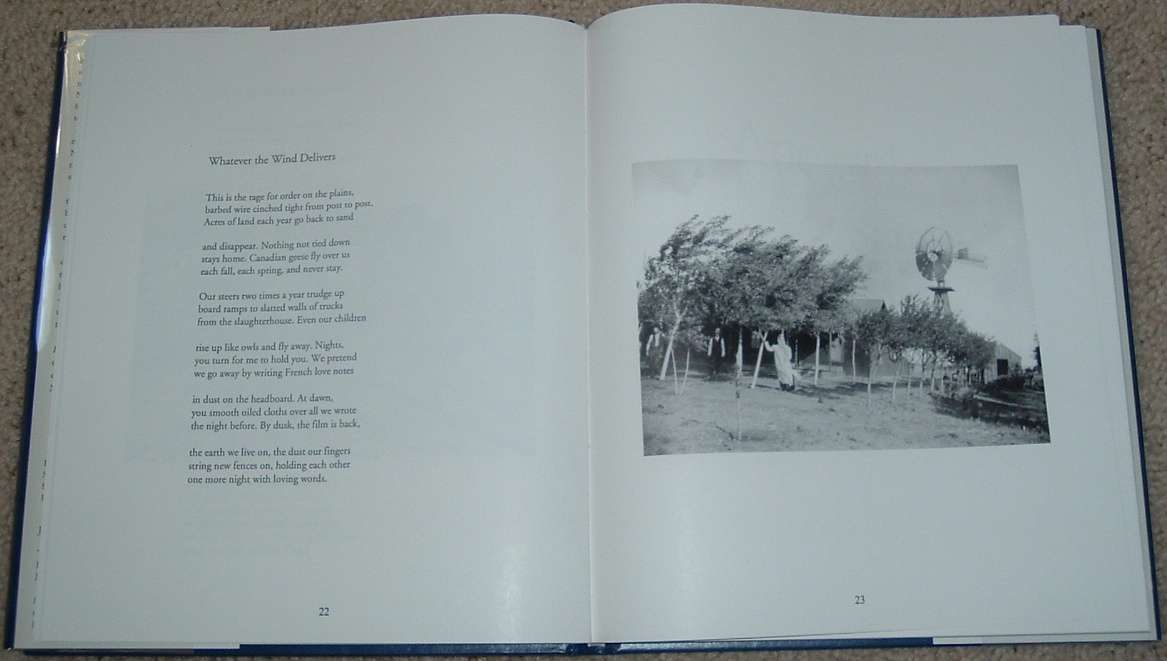
Whatever the Wind Delivers: Celebrating Texas and the Near Southwest, New and Selected Poems by Walt McDonald, with Photographs of the Southwest Collection Selected by Janet Neugebauer, Foreword by Laura Bush (1999)
I spoke to Mr. Parsons of my admiration for McDonald's writing and he was kind enough to extend the offer of obtaining McDonald's signature on each of the books when he returned to Lubbock. As McDonald still had an office at the university, Parsons would see him when he came in and get the autographs. I received the books in the mail a few weeks later, signed as promised. That was very thoughtful and very much appreciated from both Parsons and McDonald.

When I read May Sarton's passage above, I knew instantly I would share some of McDonald's writing here. His poetry celebrates the relationship of the vast land and sky of the Texas Plains and its inhabitants, man and beast alike. Themes of survival, aging, death and the inherent paradox of beauty and struggle that we are given each day on this earth comprise the artistry of McDonald's writing.

Laura Bush, a West Texas native, writes eloquently in her Foreword for Whatever the Wind Delivers:
Despite its paradoxical nature, or perhaps because of it, the region commands the respect of its inhabitants. If one thing could be said of those whose lives and livelihoods revolve around the place, it is that they don't simply live on or off the land; they live with it--and thrive.

To survive, every day is a negotiation, an agreement, an acceptance of terms that the soil and the sky outline without the slightest bit of consideration. And yet, even at its worst--at its dustiest, hottest, and driest--the region is rich with anticipation and hope for a merciful change. And it does change.

This is the paradox of West Texas and the mighty Southwest. It is at once dull and unpredictable; subtle and grand.
She could have been writing about the substance of McDonald's poems instead of the region he inhabits. Perhaps she was in a metaphorical sense. McDonald has "lived with the land" and his talent for observation from the ground as well as from a pilot's wide perspective in the sky has inspired his poetic art for capturing the essence of it all. Examples of that art follow.

First up, a few poems from Great Lonely Places of the Texas Plains:


A Round Horizon Without a Town

The prairie on any day is endless,
too much to take in between blinks.
My wife and I aren't Atlas
toting the world. We carry the cosmos,
not a globe but stars and rocks

in a billion different directions,
if we could track them, like canoeing
the Brazos River after a rain,
ripples and flow forever changing.
Horizon is fragile on the Plains.

Grazing cattle shift, the buzzards glide,
vast details that don't match. Boots
and horses' hooves turn the globe,
and skyline rolls. We raised four babies
on the Plains. They toddled off and fell,

shoved up and now they're gone.
Explorers learned the signs,
established trails highways bypass.
Step any direction and pastures shift,
a herd of antelopes galloping

while binoculars change hands,
strap quickly off and my wife
lifting them with a twist to fit
her eyes, counting four pronghorns
or five, not the ten I claimed I saw.
Leaving Sixty

Riding flat, hardscrabble plains,
we hold the reins of geldings
with fingers stiff in leather gloves.
The sun burns mirages blue as oceans:
Shanghaied, we're trapped in a fleet
of boats, these creaky bones.

Charming Columbus, his scrolls
rolled into a globe, his tales of gold
and spice enticing. Look ahoy,
they're dropping off the horizon,
old friends once young as Columbus.
The world is flat: Isabella's fool

proved that by dying, leaving a skull,
the only gold of a dunce.
Columbus found the edge of the earth
years later, and no charts
or spinning globe could save him.
Only his nurse saw the old man vanish.

Far from port, my wife and I
wave semaphores of love
like Santa Maria scrolls:
We're headed west, loaded with gold
and spice, stiff riggings locked,
no way to shift the sails.
And from Whatever the Wind Delivers, here is the title poem about the negotiation and acceptance Mrs. Bush wrote about and the struggle to take what comes and thrive:


Whatever the Wind Delivers

This is the rage for order on the plains,
barbed wire clenched tight from post to post.
Acres of land each year go back to sand

and disappear. Nothing not tied down
stays home. Canadian geese fly over us
each fall, each spring, and never stay.

Our steers two times a year trudge up
board ramps to slatted walls of trucks
from the slaughterhouse. Even our children

rise up like owls and fly away. Nights,
you turn for me to hold you. We pretend
we go away by writing French love notes

in dust on the headboard. At dawn,
you smooth oiled cloths over all we wrote
the night before. By dusk, the film is back,

the earth we live on, the dust our fingers
string new fences on, holding each other
one more night with loving words.

Tuesday, February 09, 2010

The Orphans' Nine Commandments

When I met William R. Holman last month, the author of The Orphans' Nine Commandments (TCU Press, 2008), I couldn't have known of the overwhelming adversity this man had to overcome to be where he was at that point in time, telling me about the broadsides in my hands that he and his wife designed, about the books he had designed and printed, his work with libraries, and even showing me his wife's picture in the book and speaking so lovingly of her.

As he talked about the book, a narrative began to unfold that could have undermined the success and happiness so evident in my brief meeting with him. He showed me the book mark with its teaser about his incredible journey and a quote from Larry McMurtry. And then he asked me to please let him know what I thought of the book. He indicated his contact information on the bookmark with red notation.

I would encourage anyone to read this powerful and engaging memoir and let Mr. Holman know your thoughts. I did and what follows is a modified version of that correspondence with Mr. Holman.


The first chapter of The Orphans' Nine Commandments will knock the wind out of you and lay the foundation for the emotional, gut-wrenching journey a young boy (Holman) is forced to take through orphanages and foster homes during the 1930s and the Great Depression.

As you recover from the shock of what happened to William, who starts out in life as Roger Bechan and is given new names along the way, you'll learn of the human spirit to adapt and survive, even in a little boy stripped of his family, home, and name. This compelling memoir is fraught with cruelty from adults and countered with the resilience and adventure of a young boy growing to manhood, carving out, painstakingly, an existence and new identity for which he seeks meaning and worth and, above all, love and acceptance.

Larry McMurtry calls Holman's book "an important and compelling memoir." Of Holman's struggle and private hell, McMurtry states further that Holman will take his readers along in a way "that will move you, inform you, and haunt you."

This is a horror story as well as a success story. It's repugnant and poignant, humorous and jubilant. Mr. Holman succeeds in taking us lockstep through his darkened childhood with vivid detail against a backdrop of characters, good and evil alike. At times, it reads like a picaresque novel with the pathos and humor of Dickens and Twain.

The reward in the reading is the triumph of the spirit with threads of hope for love and understanding woven into an achievement of family and success, against overwhelming adversity in the formative years.

Monday, February 01, 2010

Survive, Man! (and Steer)

My trip to the warehouse to retrieve a book this morning turned into an eerie confluence of words, music, art, and imagery.

About 9 a.m., I head east on the Farm-to-Market road out of my neighborhood for the quick five-minute drive to pick up the last sale of January--an order that came in late last night for a book called Survive, Man! Or Perish: Sculptural Metaphors That Command Allegiance to Life, Resistance to Race Suicide, with the Art of Survival: a Critique of the Survivalist Art and Philosophy of Randolph W. Johnston.


I tune in to The Motor City Hay Ride with Don Was on Sirius and pick up a Grateful Dead song, the twangy country strains of Dire Wolf, with the lyrics, Don't murder me. Please, don't murder me. A tenuous connection there between book title and song.

But a second or two later, I spot a Longhorn steer making his way nervously down the shoulder on the west-bound lane. He's busted out of a nearby ranch and is making his getaway.

Now, I get it! The book title, the song lyrics, the runaway survivalist steer! Don't murder me, the Grateful Dead call out. The book I'm about to pick up encourages, Survive, Man! I'm wishing I had my camera with me, as the runaway steer trots across the gravel entrance of a business parking lot.

I fetch the book and double back to the west, hoping to pick up the trail of the Longhorn. He's nowhere in sight. Must have gone into some adjacent brush. And maybe he survived whatever Dire Wolf it was that put him on the highway. I've lost him.

But back home with the book, I find some interesting sculptures from an equally interesting artist, Ran Johnston. At the Mother Earth News, I discover a profile on Johnston (the best available--not much on this elusive man), which starts out with the following:
Back in the '20's, Canadian sculptor Randolph W. Johnston coined a word—Megamachine—to describe a society that swallowed people up and excreted them as look-alike pellets. And it was back then that the young sculptor conjured a dream of being able to leave the Megamachine to live in freedom, alone, on a tropical island.
So the metaphorical coincidences continue for the escaped Longhorn...


Sunday, January 31, 2010

Big books


The Klencke Atlas holds the distinction of being the biggest book on the planet at about five feet tall and six feet wide. It's never been publicly displayed with its pages open, but that's about to change. The 350-year-old atlas will be displayed as part of the British Library exhibition on maps later this year.

Not to be outdone (actually I have been), here's my biggest book--a collection of New York Times newspapers from 1936, hardbound by the New York Public Library.


While it takes six people to hoist the Klencke Atlas, I can lift my Times book all by myself. I'm over six feet tall, so you get an idea from the photo how big my book is. At two feet, eight inches tall by a foot-and-a-half wide, it's not exactly dwarfed in my hands. It wasn't that easy to hold open. I only thought I was holding a Krecke Atlas! So I can't imagine actually trying to wrestle with that monster.

Following are some interesting things I found in my little bitty 1936 New York Times book.

First up is an Eastern Air Lines ad. I didn't know they went back as far as 1936, but I was pleased to find it because it complements an old Eastern ticket I have and wrote about on one of my ephemera blogs, Paper Matters. Some pretty cool video of the old "Connies" in that post.


Next, President Roosevelt pays a visit to Oklahoma during the Dust Bowl days. Deep into the Great Depression, Roosevelt hits the road to visit those who are really suffering through some tough times.


Back east, Carl Hubbell and the New York Giants are playing some good baseball on the way to the National League Pennant. I know all this because I used to hear first-hand stories from one of Hubbell's teammates, Joe Moore, the left fielder. That's a subject for another time, but I got to know Joe and become friends with him for a good ten years before he passed away in 2001 at age 92. He had a bunch of articles like this in a scrapbook. So you can see why I had to include this one.


The Yankees also made it to the World Series in '36 and whipped the Giants. I'm a huge Lou Gehrig fan so was pleased to find him doing a pitch for anything--in this ad it's milk.


Entertainers from yesteryear are in these old radio ads.


Here's the patriarch of the Kennedy clan, before the Kennedy machine started cranking out political leaders. Looks like he's doing okay with the Roosevelt administration in the White House.


Down on the farm, the latest technology in farm equipment promises to boost production. You might be able to find one of these in a museum now.


The New York Times wouldn't be complete without news and reviews of books. Here are a few pages from yesteryear and old books that were once new with stiff bindings on the shelves.


There's so many interesting articles, ads, and photos--I could go on and on with the history found on these pages, but need to stop here.